
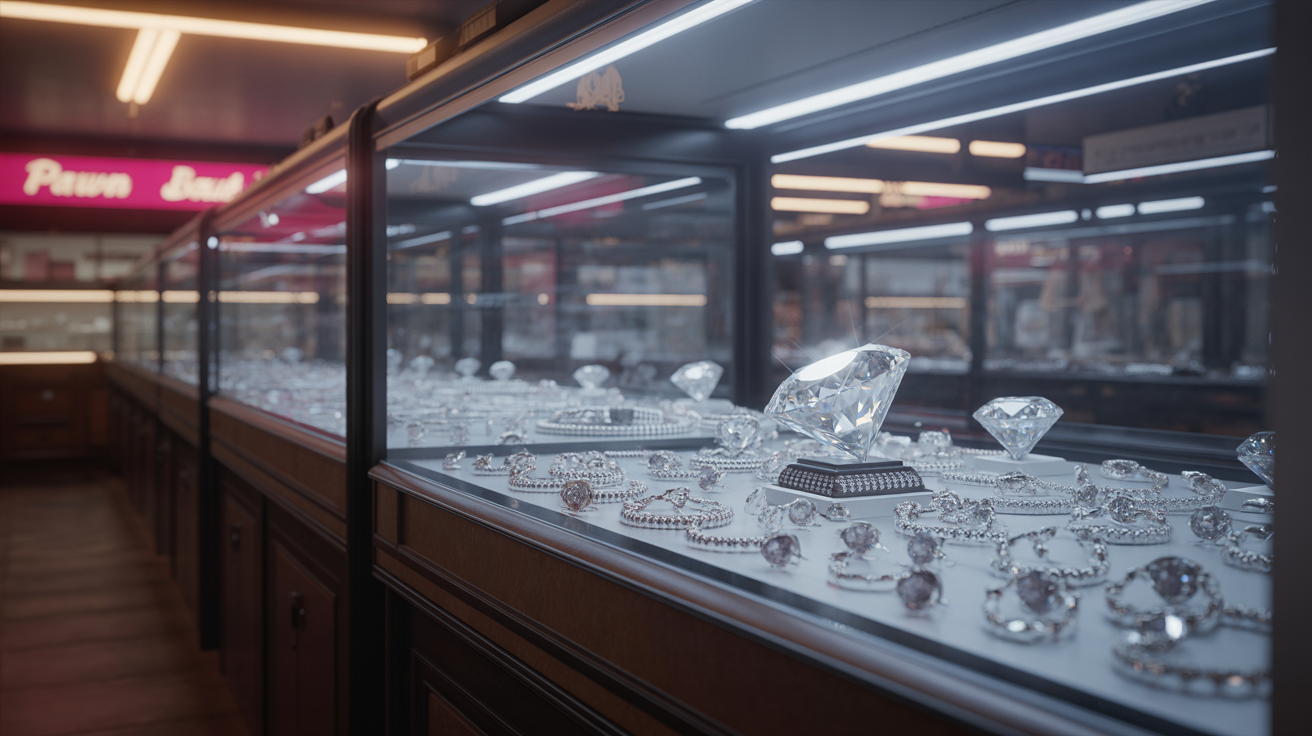
Do pawn shops buy diamonds? Yes, but they offer the lowest payouts in the diamond resale market. Most pawnshops pay just 15-25% of retail value because they lack gemologist expertise and rely on quick-flip pricing models.
Key Takeaways:
• Pawnshops typically pay 15-25% of retail value for diamonds, compared to 35-45% from specialist diamond buyers
• Most pawnshop staff lack certified gemologist training to properly evaluate diamond quality and authenticity
• Cash Converters and Ramsdens process diamond sales within 24 hours, making them suitable for emergency cash needs
Do Pawn Shops Actually Buy Diamonds?

Pawnshop diamond buying is a straightforward service offered by major UK chains. Cash Converters accepts diamond jewellery with stones of 0.25 carats or larger. Ramsdens processes diamond purchases at most branches. Both chains require valid UK hallmarks on gold settings.
However, their acceptance criteria limit what they’ll consider. Most pawnshops won’t touch loose diamonds without settings. They refuse diamonds under 0.25 carats because resale margins are too thin. Stones without visible inclusions get scrutinised heavily, as many staff can’t distinguish between natural and lab-grown diamonds.
The process is immediate but basic. Staff use simple loupe magnification and electronic diamond testers. They weigh the piece, check for hallmarks, and make an instant offer. No detailed grading occurs. No certificates are issued. You walk in with a ring, leave with cash or nothing.
Cash Converters maintains a 0.25 carat minimum requirement for all diamond purchases across their network.
How Much Do Pawn Shops Actually Pay for Diamonds?

| Diamond Example | Retail Value | Pawnshop Offer | Specialist Buyer | Percentage Gap |
|---|---|---|---|---|
| 1ct G/SI1 solitaire | £4,000 | £600-1,000 | £1,400-1,800 | 10-20 percentage points |
| 2ct H/VS2 ring | £8,500 | £1,700-2,100 | £2,975-3,825 | 15 percentage points |
| 0.5ct F/VVS1 earrings | £2,200 | £330-550 | £770-990 | 20 percentage points |
Pawnshop payouts average 15-25% of retail value across all diamond sizes and qualities. This reflects their business model, not the stone’s worth. They price for immediate resale to trade buyers who demand steep discounts.
Smaller diamonds get hammered hardest. Stones under 1 carat often fetch just 15% of retail because wholesale demand is weak. Larger stones fare slightly better at 20-25%, but still trail specialist buyers by significant margins.
The diamond resale market rewards expertise and patience. Pawnshops offer neither, so they compensate with ultra-low purchase prices that guarantee profit regardless of final sale outcome.
Why Pawn Shop Diamond Valuations Are Often Wrong

- No spectroscopy equipment to distinguish natural from lab-grown diamonds, leading to incorrect pricing assumptions
- Missing master stone sets for accurate colour grading, resulting in stones being undervalued by 1-2 colour grades
- Basic electronic testers only that confirm diamond presence but can’t assess quality grades
- Inadequate lighting systems that prevent proper clarity assessment under standardised conditions
- Limited magnification tools beyond simple 10x loupes, missing inclusions that affect grading
Most pawnshop staff lack certified gemologist training through organisations like the Gemmological Association of Great Britain. They rely on basic visual assessment and electronic confirmation that a stone is diamond rather than simulant.
This creates systematic undervaluation. A stone that grades G/SI1 under proper gemologist valuation might be assessed as J/I1 by pawnshop staff using inadequate equipment. The price difference between these grades can exceed 40% of the stone’s true value.
Gemologist valuation requires calibrated instruments, controlled lighting, and formal training that most pawnshops simply don’t invest in.
When Does Selling to a Pawn Shop Actually Make Sense?

- Assess your timeline urgency by calculating whether you need cash within 24-48 hours for genuine emergencies
- Evaluate your diamond’s specifications to confirm it’s under 1 carat with no certification, making specialist buyers less viable
- Check local pawnshop availability by visiting branches during business hours rather than relying on postal services
- Accept the price penalty by calculating whether immediate access to 15-25% of retail value solves your specific problem
- Compare total convenience costs including travel time, documentation requirements, and opportunity cost of waiting
Emergency cash needs justify pawnshop convenience despite lower payouts. If you need money for urgent bills, medical expenses, or time-sensitive opportunities, the speed advantage matters more than maximising price.
Diamond postal selling to specialist buyers requires 5-10 business days minimum. Auction processes take 6-12 weeks. Local specialist buyers need appointments and may require multiple visits for final offers.
Pawnshops complete transactions within hours, making them suitable when time constraints override financial optimisation.
Pawn Shop vs Specialist Diamond Buyer: The Real Numbers

| Factor | Pawnshop | Specialist Diamond Buyer | Difference |
|---|---|---|---|
| Typical payout | 15-25% retail | 35-45% retail | 20 percentage points |
| Processing time | Same day | 5-10 business days | Speed vs price trade-off |
| Gemology expertise | Basic testing only | Certified gemologist assessment | Professional grading |
| Equipment quality | Electronic testers, basic loupes | Full laboratory setup | Industry-standard tools |
| Documentation provided | Receipt only | Detailed grading report | Comprehensive analysis |
Specialist buyers consistently outpay pawnshops by 10-20 percentage points across all diamond categories. A 2-carat diamond ring worth £8,500 retail might fetch £2,000 from a pawnshop but £3,500 from a specialist buyer.
This gap exists because specialists understand RapNet diamond pricing and have established relationships within the diamond auction market. They can afford higher payouts because they achieve better wholesale prices through industry connections.
Processing time represents the core trade-off. Pawnshops offer immediate liquidity but at significant cost. Specialist buyers require patience but deliver substantially higher returns.
The diamond buyer expertise difference is stark. Specialists employ certified gemologists who can accurately grade colour, clarity, cut, and carat weight using calibrated equipment. This professional assessment translates directly into higher purchase offers.
Frequently Asked Questions
How much do pawn shops pay for diamonds?
Pawnshops typically pay 15-25% of retail value for diamonds, significantly lower than specialist diamond buyers who pay 35-45%. The exact amount depends on carat weight, clarity, and current gold prices for the setting.
What is the pawnshop diamond price compared to retail?
Pawnshop diamond prices average 20% of original retail value, while insurance replacement values typically show 60-80% of retail. This gap exists because pawnshops price for quick resale rather than replacement value.
Does Cash Converters buy diamond rings?
Cash Converters accepts diamond rings with minimum 0.25 carat stones and valid UK hallmarks on gold settings. They typically pay 15-20% of retail value and complete transactions within 24 hours.